The short answer
If your customers search in more than one language, yes, because Google can only show them a page that exists in their language. For most businesses in Cyprus that means Greek and English, and sometimes a third language for buyers or visitors from abroad. Each language needs its own pages and web addresses, a full translation of the main text, and links that tell Google the versions belong together. A translate button or a half-translated page does not do that job.
Contents
Which languages do your customers search in?
Start with the people who buy from you, not with a list of languages. A business that serves local customers is searched for mostly in Greek, while residents from abroad, companies and visitors search in English. Visitors matter in Cyprus: in July 2026, 31.9% of tourist arrivals came from the United Kingdom and 20.5% from Israel, according to the Cyprus Statistical Service (Cyprus Mail, 2 October 2026). In August the two shares were 30.5% and 23.3% (Cyprus Mail, 30 October 2026).
| Your customers | Languages to consider |
|---|---|
| Mostly people living in Cyprus | Greek and English |
| Companies, foreign residents and visitors | English first, with Greek |
| Buyers or guests from a specific country | Greek and English, plus that country’s language once you can answer its enquiries |
A third language is worth adding only when you can also reply to messages and calls in it. A website in Russian or Hebrew that leads to an answer in another language disappoints the visitor it was built for.
How does Google know which language to show?
Google reads the page. It says it uses “the visible content of your page to determine its language”, and not code such as the lang attribute or the web address (Google Search Central: Managing multi-regional and multilingual sites). That is why the main text has to be in the language itself.
Google also recommends a separate web address for each language version, rather than switching the language with cookies or browser settings (Google). Its crawler sends requests without saying which language it prefers, so a website that changes language by itself may never show Google its other versions (Google Search Central: How Google crawls locale-adaptive pages).
Hreflang links then tell Google that the English and Greek pages are versions of each other, so each searcher is offered the right one. Every version has to list itself and all the others. If two pages do not point to each other, Google ignores the links (Google Search Central: Tell Google about localized versions of your page).
What does a proper second language need?
- Its own web address. For example, English at yourdomain.com/services/ and Greek at yourdomain.com/el/services/.
- The main text translated, not only the menus. Google warns that translating only the navigation and footer, while the content stays in one language, can make a poor experience (Google).
- One language per page. Google advises against putting translations side by side on the same page (Google).
- A visible language switch that leads to the same page in the other language, not to the home page.
- No automatic redirects. Google advises against sending people to a language version by guessing, because it can stop users and search engines from seeing every version (Google).
- Hreflang links on every page, including an x-default page for anyone whose language you do not offer (Google).
- Every word a customer meets: page titles, descriptions, forms, buttons, emails and error messages.
| Structure | Example | What Google says |
|---|---|---|
| Folder | yourdomain.com/el/ | Easy to set up and low maintenance, on the same host |
| Subdomain | el.yourdomain.com | Easy to set up, and can sit on a different server |
| Separate country domain | yourdomain.gr | Clear country targeting, but expensive and needs more infrastructure |
| URL parameter | yourdomain.com?lang=el | Not recommended |
The table summarises Google’s own comparison (Managing multi-regional and multilingual sites). For a business in Cyprus that wants languages rather than separate countries, a folder for each language on one domain is usually the simplest choice.
Is machine translation good enough?
As a first draft, often yes. As the final text, rarely. Google does not ban translated pages. Its spam policies target translation used to churn out many pages “where little value is provided to users” (Google Search Central: Spam policies). Its guidance on helpful content gives “translating a poem manually” as an example of high effort (Google Search Central: Creating helpful content).
The bigger risk is your customers. A sentence that is grammatical but that nobody would say tells a reader the page was not written for them, and a wrong word in a price, an opening time or a booking form costs you the enquiry. Have a native speaker read every page before it goes live, especially prices, forms and anything legal.
What does it look like in practice?
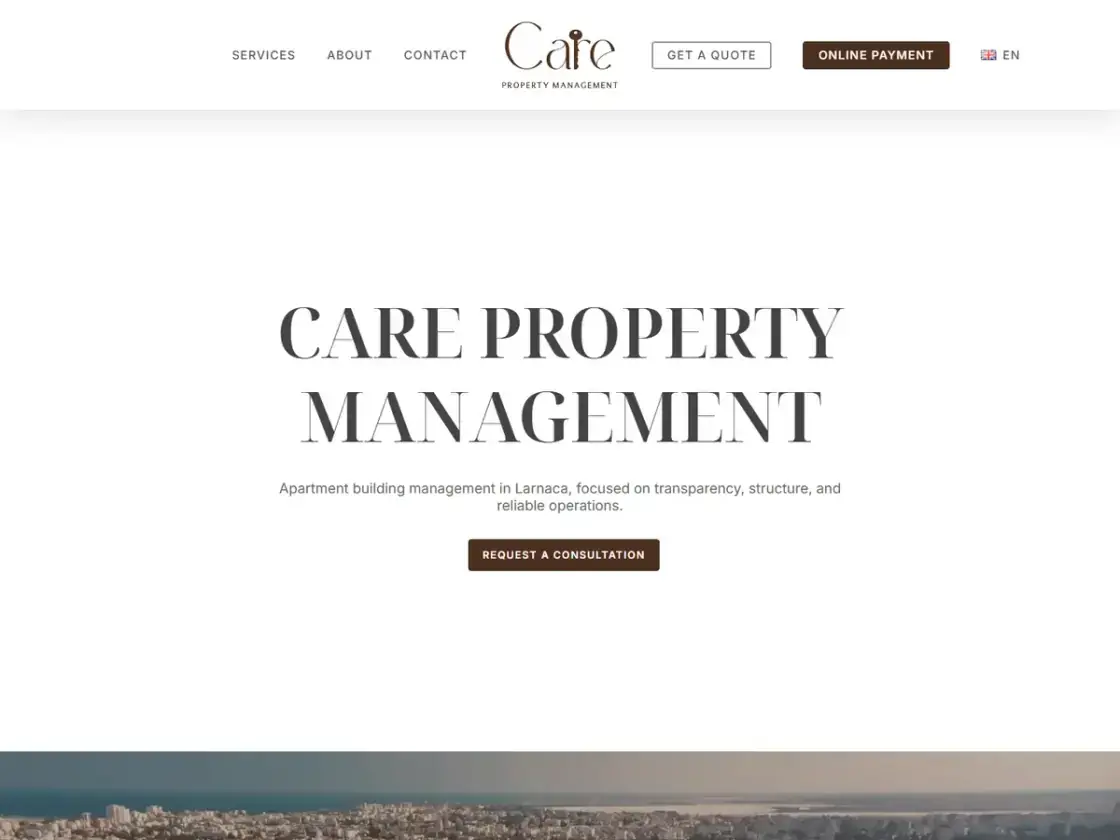
Care Property Management in Larnaca has a website we designed and built in 2025, in English and Greek, with a page for each of its 9 services. As of November 2026, it ranks first on Google in Cyprus for “building management Larnaca” and for the same search in Greek, “διαχείριση πολυκατοικιών Λάρνακα”.
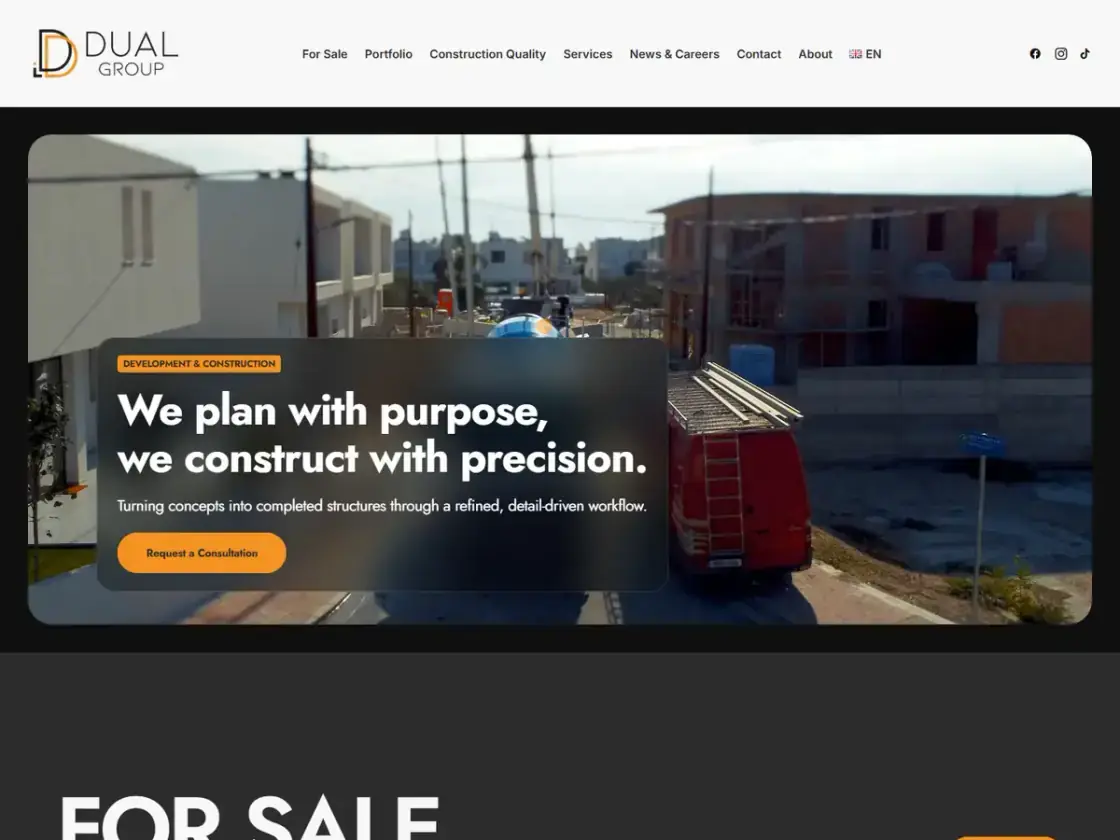
DUAL Group, a property developer in Larnaca, has a website in English and Greek too. Each of its 9 projects has its own page, with a table of every unit, so a buyer can read the same facts in either language.
Our own website, and the booking system on it, work in English, Greek, Hebrew and Russian, with Hebrew written from right to left. Before launch, native speakers of Hebrew and Russian read every page.
What does a second language add to the work?
More than the translation itself. Every page, title, form and email exists twice, and each change you make later has to be made in both languages, or the two versions slowly drift apart. Hebrew also turns the whole layout around, because the text runs from right to left. What a website costs in Cyprus, and what changes the price, is in our cost guide.
If your website already has both languages but does not appear on Google, start with why a website may not show on Google. If you take bookings online, read how online booking works for a small business. We design and build multilingual websites through our Web Design and Web Development services.
How we wrote this: how Google handles languages is from Google Search Central, checked 14 November 2026. The tourism figures are the Cyprus Statistical Service’s, as reported by Cyprus Mail on 2 and 30 October 2026. The Care Property Management position was checked in November 2026. The projects are our own work.
Key takeaways
- Google decides a page’s language from the text people can see, so the main text has to be translated, not only the menus.
- Give each language its own web address, such as /el/ for Greek, and link every page to its other versions.
- Do not send visitors to a language automatically by guessing. Let them choose.
- Machine translation is a draft. A native speaker should read every page before it goes live.